
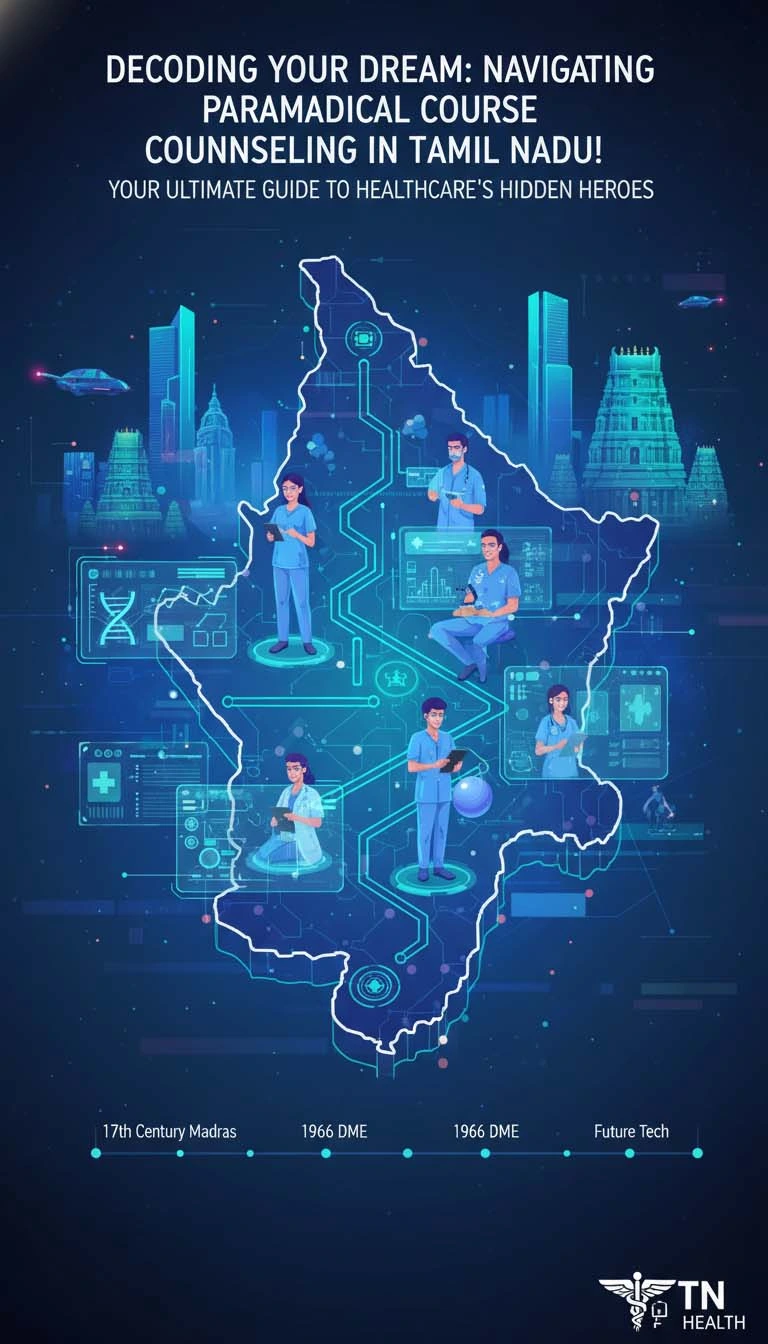
Navigating Paramedical Course Counseling in Tamil Nadu!
Your comprehensive guide to understanding and excelling in the paramedical education landscape of Tamil Nadu.
I. Introduction: Your Gateway to Healthcare's Hidden Heroes!
Ever thought about a career in healthcare that isn’t a doctor or a nurse, but is just as vital? Meet the paramedical pros! These individuals form the backbone of our medical system. What are paramedical courses, you ask? In short, they represent the specialized support system—the diagnostic detectives, therapeutic wizards, and rehabilitation champions who keep the medical world spinning. Consider the lab technicians meticulously analyzing samples, the radiographers capturing vital images, or the physical therapists guiding patients back to mobility.
Tamil Nadu, with its rich history of medical innovation and a growing demand for skilled healthcare professionals, stands as a significant hub for paramedical education. The state’s commitment to healthcare accessibility and quality fuels the need for well-trained paramedical staff. But the path to joining these ranks begins with understanding the counseling process. How do you even get into these amazing programs, especially through the often-perplexing counseling process? Let’s break it down!
II. A Walk Down Memory Lane: How Paramedical Education Grew Up in TN
To truly appreciate the present, we must glance at the past. Healthcare training in the Madras Presidency has roots stretching back to the 17th century, with rudimentary medical practices in its hospitals and the emergence of 19th-century midwives. These were the nascent stages of what would become formalized healthcare professions.
Consider the “apothecaries” and “dressers” at Madras Medical School – the original allied health professionals, dispensing remedies and tending to wounds long before the term “paramedic” existed. Their roles, though basic by today’s standards, were indispensable.
The true turning point arrived in 1966 with the birth of the Directorate of Medical Education (DME). This marked a pivotal moment. Tamil Nadu became a pioneer in structuring medical and paramedical education, laying the foundation for the organized system we see today. Admissions gradually evolved from cumbersome paper forms and nerve-wracking interviews to today’s relatively streamlined online system.
III. The Playbook: What Current Counseling Looks Like
The current counseling process hinges on a few key tenets. First, admission isn’t primarily about entrance exams (for most courses, at least!). Rather, it’s your performance in Class 12 that carries the most weight. Second, the entire process is conducted online, overseen by the DME.
Are You Eligible? The Checklist:
- You must be born in India and either a native of Tamil Nadu or have parents who are permanent residents.
- Age check: Must be 17 by December 31st of the admission year.
- Academics: Passed Class 12 with Physics, Chemistry, and Biology (or Math for specific courses). A minimum aggregate of 50% is usually required (45% for SC/ST candidates).
A diverse range of courses awaits those who meet these criteria. From the ever-popular B.Sc. Nursing to the intricate world of Bachelor of Physiotherapy, the analytical skills of BMLT (Bachelor of Medical Laboratory Technology), the precision of Optometry, and the technological expertise of Radiology – a whole world of specialization awaits!
And where can you pursue these specialties? Tamil Nadu boasts a plethora of institutions, from the prestigious SRM Institute of Science and Technology and Madras Medical College to the renowned Christian Medical College (CMC) Vellore, alongside numerous other colleges and universities across the state.
The online journey consists of six key steps:
- Application: Fill out the online form and pay the application fee (typically around Rs 500).
- Merit List: Your Class 12 scores are normalized to a score out of 200. This is your ranking benchmark.
- Counseling Registration: Pay a further small fee (Rs 200-250) to participate in the counseling process.
- Choice Filling & Locking: Select your desired courses and colleges in order of preference. This is crucial!
- Seat Allotment: The system works its magic based on your rank, choices, and applicable reservation rules. Special categories are typically considered first.
- Document Verification & Admission: The final step – present your documents, pay the fees, and secure your admission!
IV. The Good, The Bad, and The Glitchy: Voices from the Ground
Students & Parents Weigh In:
Thumbs Up: The online system offers undeniable convenience, and the availability of step-by-step YouTube guides is a boon. The merit-based selection process is generally perceived as fair.
Headaches: Technical glitches, particularly with OTP delivery, can be frustrating. Confusing instructions regarding required certificates are another common pain point. The fear of application rejection looms large.
Parental Pointers: Parents play an indispensable role, often assisting with applications, gathering documents, and providing career guidance.
The Educator's Angle:
Beyond scores, educators emphasize the importance of practical skills, keeping the curriculum up-to-date, and preparing students for the real-world challenges of healthcare.
Challenges persist in ensuring standardized quality across institutions and effectively bridging the gap between theoretical knowledge and practical application.
Online learning presents a double-edged sword, offering flexibility but potentially sacrificing the benefits of in-person interaction and hands-on learning.
V. Stormy Weather Ahead? Unpacking the Controversies & Challenges
The path to paramedical education isn’t without its bumps.
The “fake degree” scandals, such as the one in Coimbatore, serve as a stark reminder of the importance of verifying the accreditation and affiliation of any institution. Students were lured with promises and paid significant sums for unrecognized courses, highlighting the vulnerability of aspiring healthcare professionals.
While not strictly paramedical, broader concerns about transparency in medical recruitment hint at potential issues that could extend to allied health professions. Systemic hurdles must also be addressed.
Key Challenges:
- Quality & Access: Disparities in the quality of education and access to resources persist between institutions, particularly in rural areas.
- Ever-Changing Curriculum: The rapid pace of technological advancements in healthcare necessitates continuous updates to the curriculum.
- Standardization: Ensuring that a paramedical degree from one college holds the same value and recognition as one from another is crucial.
- The Mental Toll: The demanding nature of paramedical professions, often exacerbated by staff shortages, can take a significant mental toll, underscoring the need for better support systems.
Legal challenges to counseling processes, often brought before the Madras High Court, revolve around issues of fairness, adherence to rules, and recognition of qualifications.
VI. Looking Ahead: The Future is Bright (and Techy!) for Paramedical in TN
Despite these challenges, the future of paramedical education in Tamil Nadu appears promising. The demand for skilled paramedical professionals is fueled by a growing population, an aging demographic, and the increasing prevalence of chronic diseases.
Education Revolution:
- The focus is shifting towards “outcome-based” learning, emphasizing real-world problem-solving over rote memorization.
- Lifelong learning is becoming essential, with continuous education programs and certifications gaining prominence.
- Efforts are underway to improve practical facilities, foster hospital partnerships, and enhance emergency care training.
- Soft skills, such as patient interaction, stress management, teamwork, and empathy, are increasingly recognized as vital components of a well-rounded paramedical education.
The range of available courses continues to expand, from the foundational B.Sc. Nursing to specialized fields like Cardio-Pulmonary Perfusion, Dialysis Technology, and Physician Assistant programs.
Tech Takes Over:
- Virtual reality (VR), artificial intelligence (AI), and simulations are transforming training, allowing students to practice complex procedures without risking patient safety.
- The ability to master advanced medical equipment and even robotic surgery tools is becoming increasingly important.
- Blended learning approaches, combining online theory with hands-on clinical experience, are gaining traction.
VII. Your Path Forward: Embrace the Journey!
Paramedical education in Tamil Nadu is a dynamic, merit-based, and essential component of the healthcare ecosystem. It is a field ripe with opportunity for those seeking to make a tangible difference in people’s lives.
My final advice? Do your research, meticulously understand the online process, stay updated on the latest developments, and choose wisely. The healthcare world needs your skills, your compassion, and your dedication. The journey may have its challenges, but the rewards are immeasurable.