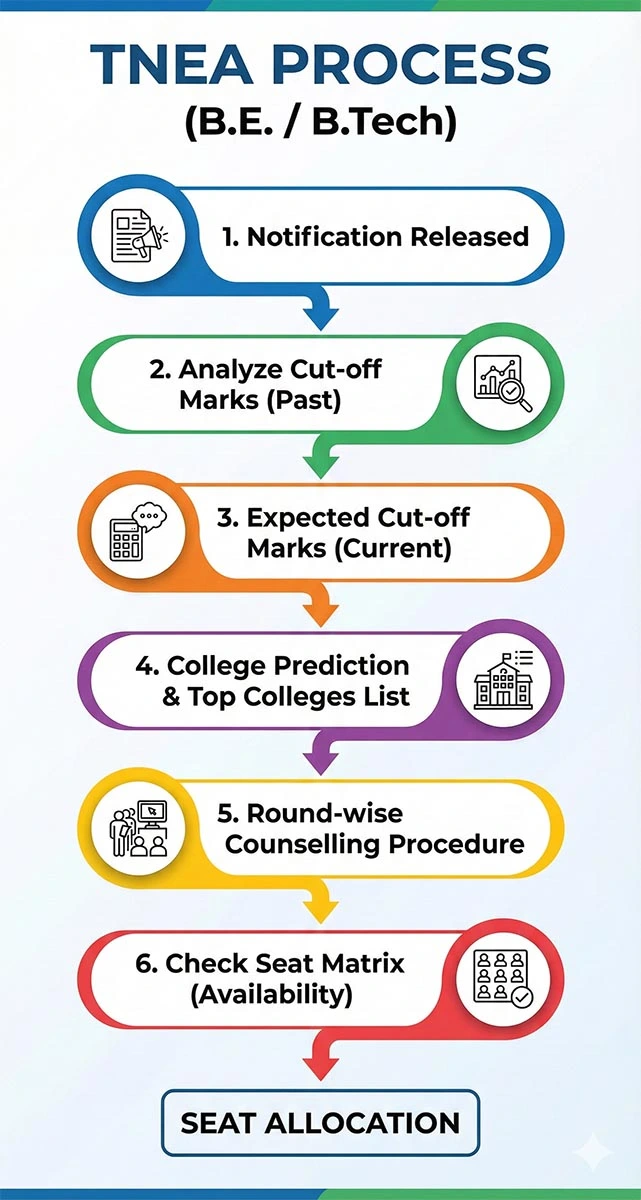
Tamil Nadu Engineering Admissions (TNEA) is a centralized, single-window counseling process run by Tamil Nadu’s Directorate of Technical Education (DoTE). Its principal goal is to make it easier for students to enroll in B.E. (Bachelor of Engineering) and B.Tech (Bachelor of Technology) programs at government, government-aided, and self-financing engineering colleges throughout the state
Engineering
TNEA
Key Characteristic: No Entrance Exam
The Selection Methodology
Candidates are ranked based on a Cut-off mark calculated out of 200.
TNEA the Counseling Process
The process is entirely online and follows these sequential stages:
- Registration & Document Upload: Students apply online and upload relevant certificates.
- Random Number Generation: Used to break ties between students with identical scores.
- Certificate Verification: Can be done online or at TNEA Facilitation Centers (TFCs).
- Rank List Publication: The merit list is released based on the cut-off calculation.
- Online Counseling: Conducted in multiple rounds based on rank. Students fill in their preferred colleges and courses (“Choice Filling”).
- Seat Allotment: Seats are allocated based on merit, community reservation (BC, MBC, SC/ST), and the student’s preference order.
Special Reservations
TNEA implements a specific 7.5% horizontal reservation for students who have studied in Tamil Nadu government schools from Class 6 to 12. There are also quotas for sports persons, differently-abled candidates, and wards of ex-servicemen.
JEE (Joint Entrance Examination)
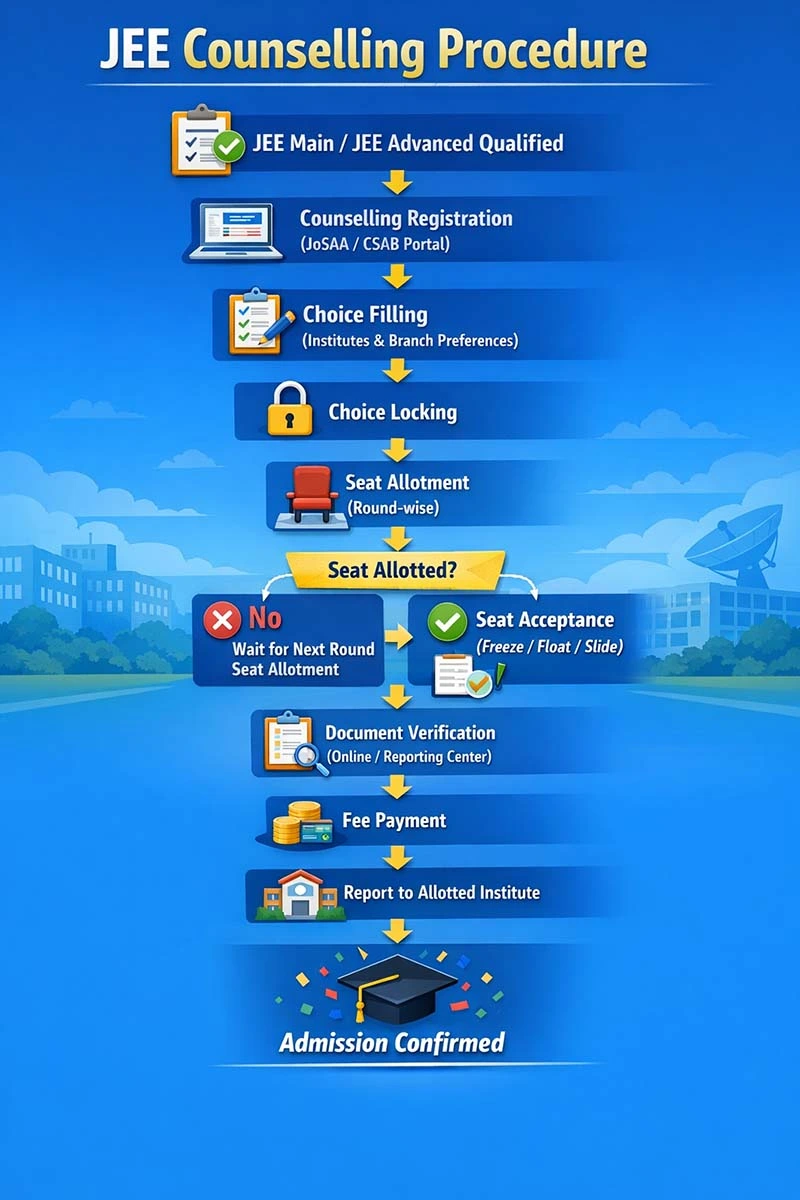
The Joint Entrance Examination (JEE) is a national-level engineering entrance exam held in India for admission to prestigious technical institutes such as the Indian Institutes of Technology (IITs), National Institutes of Technology (NITs), IIITs, and other centrally funded institutions. It is one of the most competitive exams in the country, with the goal of assessing a student’s mastery of Physics, Chemistry, and Mathematics at the senior secondary level.
JEE is conducted in two stages: JEE Main and JEE Advanced.
JEE Main is organized by the National Testing Agency (NTA) and serves as the eligibility test for JEE Advanced, as well as the entrance exam for NITs, IIITs, and other institutions.
JEE Advanced is conducted by one of the IITs on a rotational basis and is required for admission into IITs. Only top-performing candidates in JEE Main are eligible to appear for JEE Advanced.
Instead of rote study, the exam focuses on conceptual clarity, analytical thinking, and problem-solving skills. Because of the high level of competition, students typically begin preparing well in advance, often combining schoolwork with coaching or self-study. JEE performance has a significant impact on the academic and professional futures of aspiring Indian engineers.